Habitagram, my habit tracker, has a progress screen that answers “how far have I climbed?” with a picture: one continuous mountain ridge rising out of the sea, across desert, steppe, forest, and volcano, to a snowed summit. You swipe through it page by page, each page one milestone, your reached pages in color and the locked ones in grey.
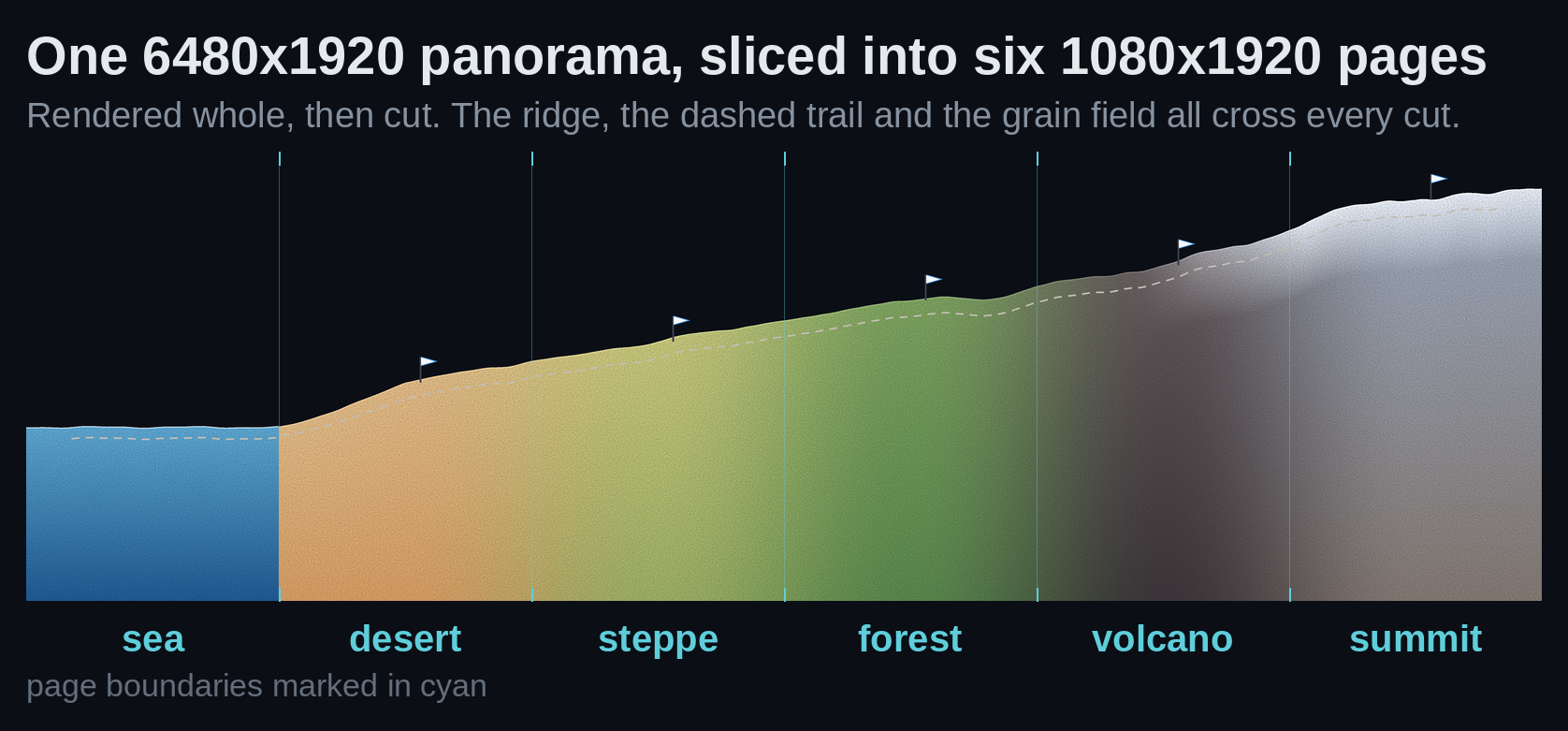
The art is a single panorama, 6480x1920, rendered by a numpy engine and sliced into six 1080x1920 portrait tiles. Slice continuous art into pages and both the display and the export get a chance to put a seam back. A green test will not tell you.
Heights are fractions, or the sea eats the desert
The ridge is a Catmull-Rom curve through one crest per biome, and the crests encode progress: desert at 20% of the climb, steppe at 38%, forest 56%, volcano 76%, summit at 100%.
The first version hard-coded crest heights as absolute pixel y-values tuned against a sea level of 1500. Then I lowered the sea level to 1300 for composition, and the desert crests ended up below the waterline. Land, underwater, silently: no error, just wrong art.
The fix is the rule: geometry that sits relative to a baseline must be stored as fractions of that baseline. Each crest is now y = lerp(sealevel, summit_y, h) with h the climb fraction, so the sea-level knob rescales the whole ridge coherently. Whenever one constant is a baseline others sit on, make the others relative, or moving the baseline breaks them all at once.
Render whole, then slice
The engine never renders a page in isolation. It draws the full 6480-wide world (ridge, waves, dashed trail, milestone flags, film grain) and then crops six tiles.
Grain is why. The texture is a woven-paper noise field generated once across the full 6480 width. Rendering per page would restart the noise at every boundary, a faint but visible jump at each swipe. Same for the ridge itself and the dashed trail’s phase. Continuity is only free if every operator sees the whole world before the knife comes out.
The greyed “locked” variants follow the same rule: the full panorama is rendered twice, color and desaturated, and both are sliced identically. Color and grey tiles are pixel-aligned by construction, so the swipe from your last reached page to the first locked one moves nothing but the palette.
The crop that undid all of it
The tiles are exactly 9:16. Modern phones are taller, and React Native’s resizeMode="cover" handles that by scaling up and cropping the sides. On a 20:9 screen that quietly removes about a tenth of each tile from each edge, a fifth of its width in all, and which tenth? The left and right edges. The exact columns where each tile connects to its neighbors.
Every seam I had engineered to be invisible became a step: swipe, and the ridge jumps sideways by the cropped amount. The art had no seams; the display manufactured them.
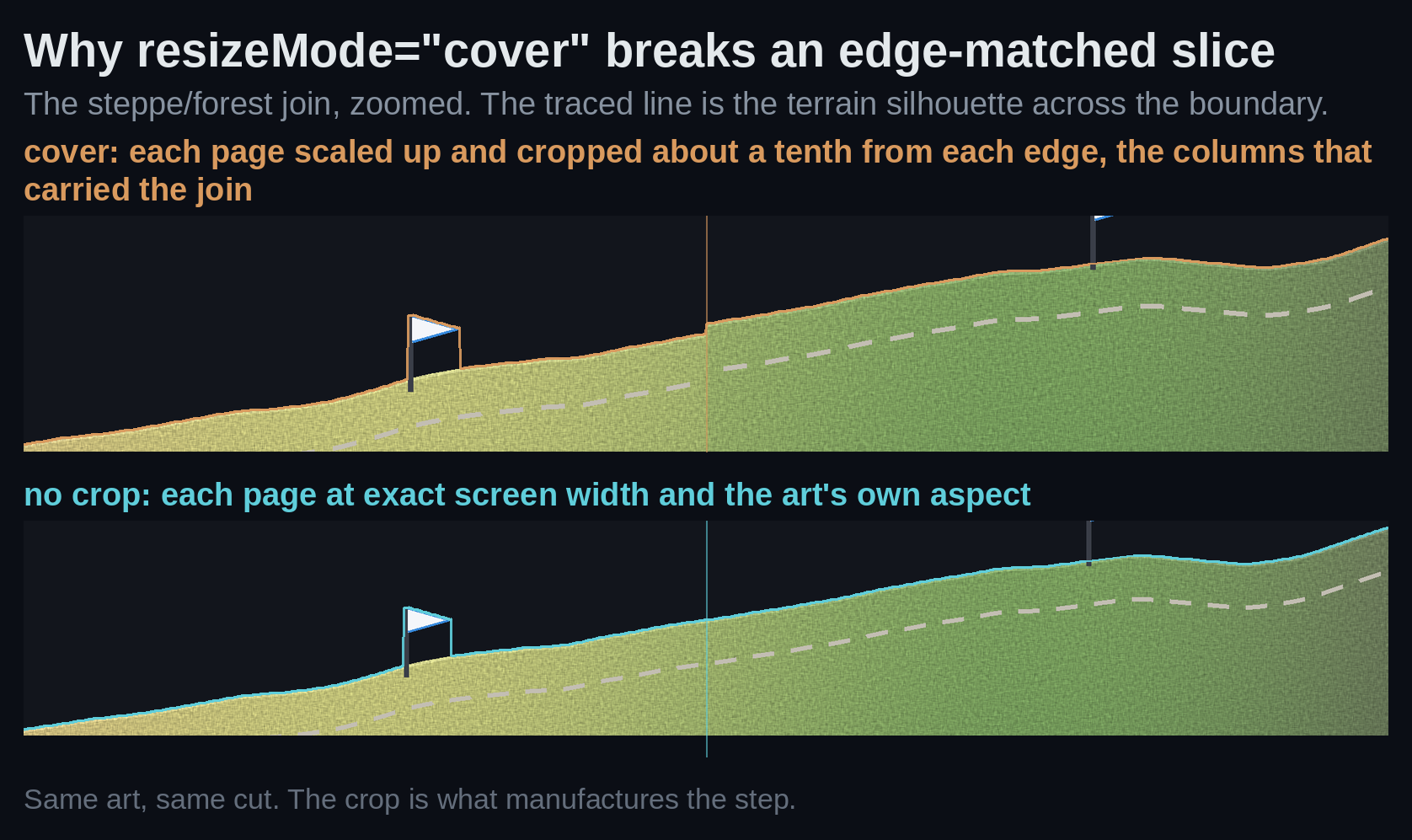
The fix inverts the layout contract. Each page renders at exact screen width with no horizontal crop, bottom-aligned so the terrain hugs the bottom and the transparent sky above blends into the theme background. Cover-crop is fine for standalone images. For edge-matched slices it is never acceptable, because the edges are the feature.
Two smaller traps
The wanderer marker sits at each page’s horizontal center, anchored per page as fractions and riding the ridge’s y at that point. Center placement is deliberate: it is the furthest a sprite can be from both seams.
And the reached-versus-locked split depends on the user’s current tier (how far up the ridge their streak has taken them), which arrives from an async query. Render before it resolves and the frontier defaults to zero, flashing the user’s own past biomes grey for a frame. The sibling journey screen already gated on the loading state; the new screen didn’t, until it did. When you copy a pattern to a new screen, copy its load-gate too.
The engine’s output is locked by golden-fingerprint tests, all twelve tiles hashed at the approved seed, so the render is pinned to the one I signed off on a real device.
The seam I put back on the way out
Writing this up, I measured the seams instead of trusting the argument. The engine draws one continuous cross-biome gradient across all 6480 pixels and cuts afterwards, so a page boundary should be indistinguishable from any other pair of adjacent columns. Across the whole strip, the median column-to-column change in brightness is 0.26. In a fresh render, the four inland seams measure 0.03, 0.10, 0.10 and 0.41. That’s the noise floor.
The tiles I actually shipped measure 2.50, 2.02, 1.66 and 0.87 at those same four seams.
The export loop runs img.quantize(colors=255) on each tile before saving it. Six pages, six independent palettes, each one fitted to a different slice of the same gradient. So the render is continuous and the files are not, and the banding is visible, not just measurable.
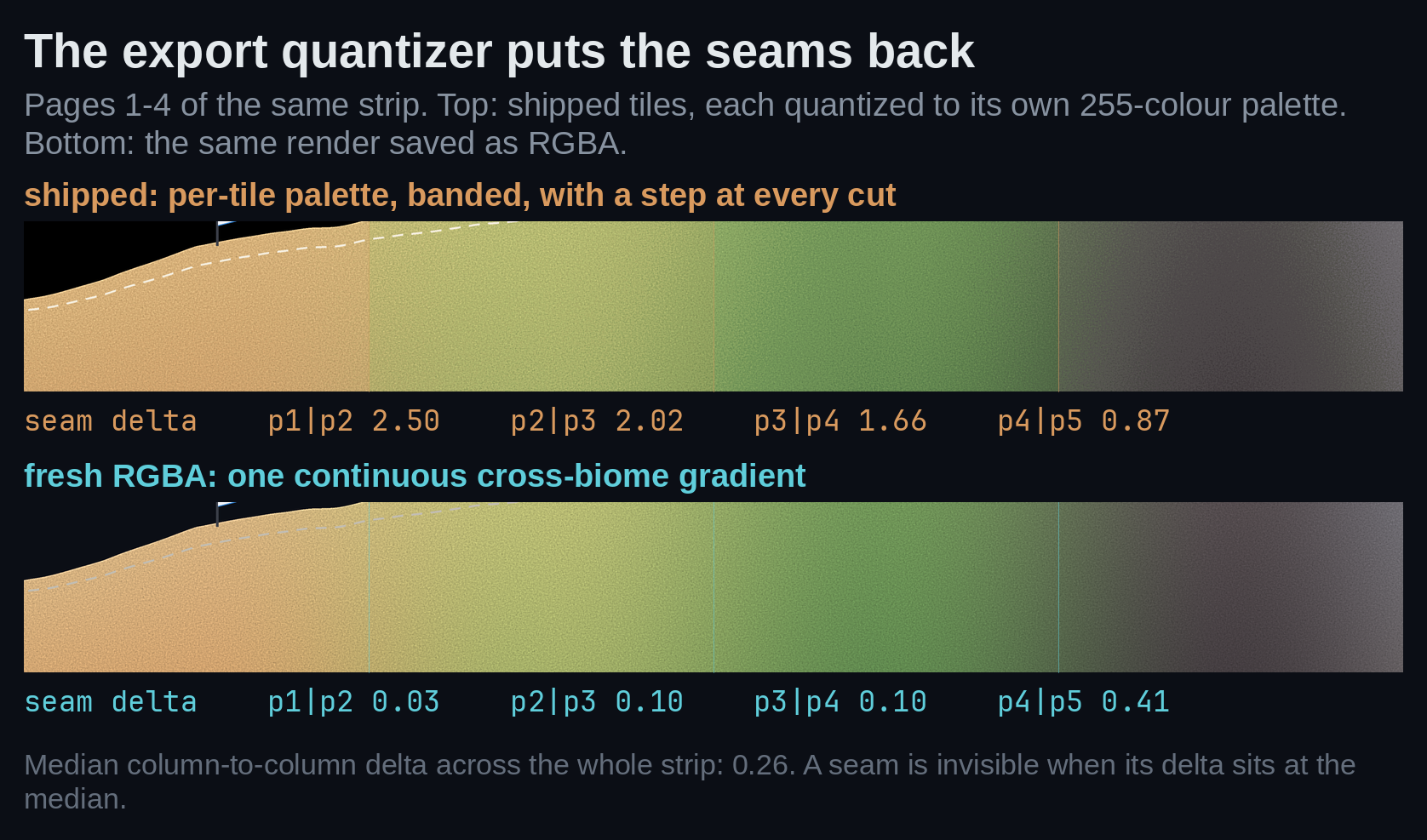
The golden tests never saw it. They pin the raw RGBA bytes of the render, so they guard the art before the knife and never look at the PNG that ships. Green the whole time.
The fix is to quantize the full strip once and slice after. Same rule as the grain and the trail: the export quantizer is an operator I forgot to count. That change is not in the engine yet; as of this writing the export loop still quantizes each tile on its own.
One boundary in that image is not a bug. The sea meets the desert at exactly one sixth of the strip because that’s where the shore is placed, and it measures the same in both renders.
If you are slicing continuous art into pages, write me: contact@markostankovic.org.