Stock and AI generators both fail the provenance test, so the stack is four engines in one folder: music.py, sfx.py, a set of scenery renderers behind one orchestrator, and vfx.py for overlay loops. No samples, no models, no downloads. If a sound exists in the output, a formula in the repo produced it. Same seed, same bytes, so the media pipeline can be tested like code.
Music from oscillators and patterns
music.py has six moods: lofi, chiptune, tension, upbeat, corporate, trap. A mood is a data block, not a separate composition. It sets the tempo, a chord progression, which instruments play, and 16-step drum patterns. Lofi runs at 75 bpm with a ii-V-I-vi progression, 16% swing, and a vinyl crackle overlay. Trap runs at 140 with a gliding 808 sub that drops seven semitones over the first third of each note.
The instruments are DSP primitives. The kick is a sine sweep from 118 Hz down to 48 Hz with a click transient. The snare is band-filtered noise plus a sine body. The marimba is a pluck with a quiet 4th and 6th partial. Humanity comes from per-hit velocity and a few milliseconds of timing jitter, all from a seeded RNG.
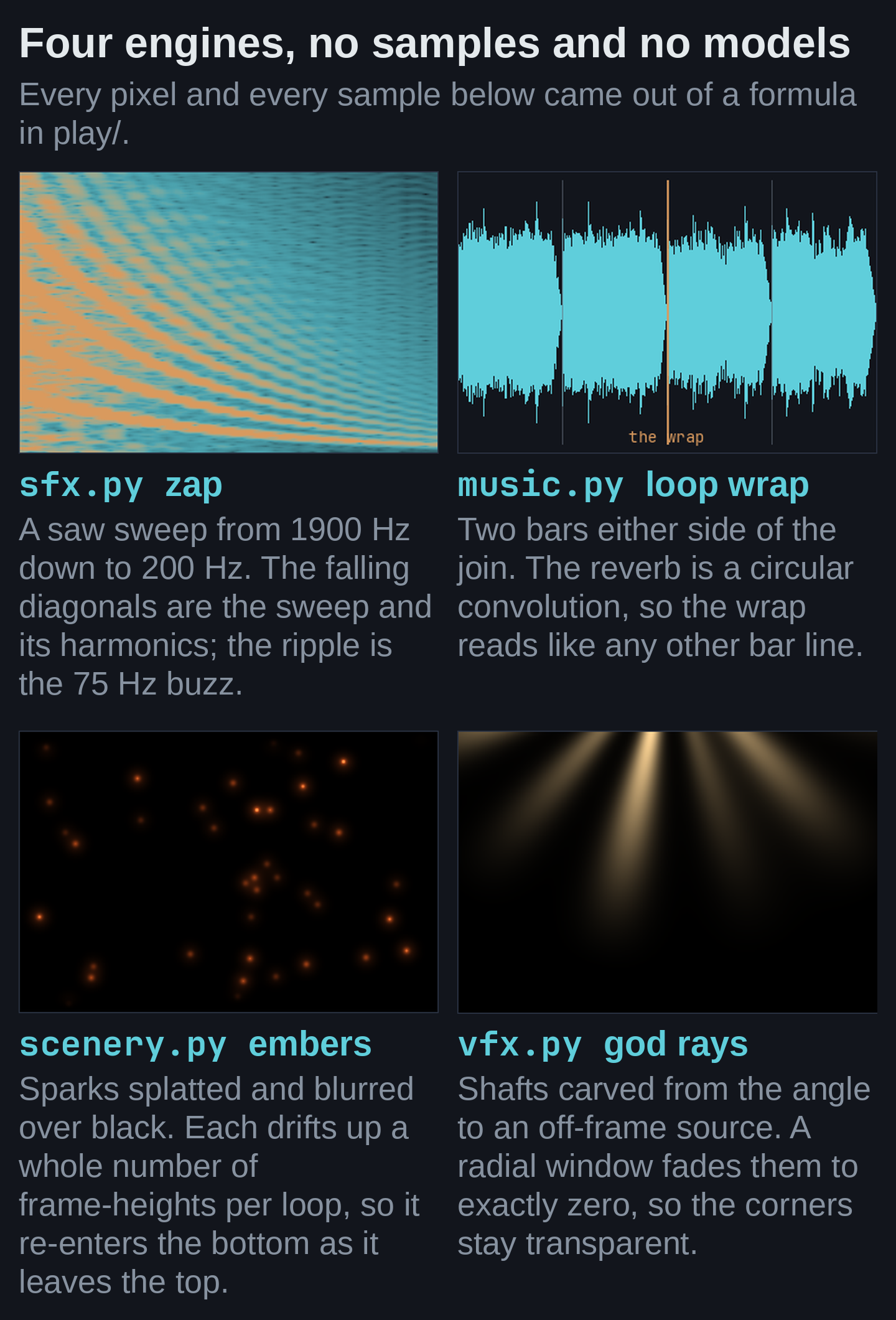
Two details make the output usable rather than a toy. First, loudness: a two-pass loudnorm to -14 LUFS with a -1.5 dB true-peak ceiling, so a rendered bed sits at streaming level without manual mastering. Second, the loop seam. The reverb is a circular convolution, so the tail of the last bar wraps around into the first. The loop closes with no crossfade and no click. The render even measures the seam delta at exit.
There is also a --stems flag that exports per-bus loops (drums, bass, pad, lead) with a manifest, which is how the same engine feeds game audio.
Sound effects are envelopes and filters
sfx.py synthesizes 33 sounds: clicks, whooshes, impacts, zaps, coins, explosions, a teleport. Each one is a small recipe. A whoosh is noise swept dark to bright and back under a hann window, panning left to right as it goes. A zap is a saw sweep from 1900 Hz to 200 Hz with a 75 Hz amplitude buzz and some crackle on top. The coin is two square waves, 988 Hz then 1319 Hz, straight out of the arcade lineage.
Every recipe takes an RNG and jitters pitch, timing, and filter cutoffs, so one seed gives one variant and the variant count is unlimited. --pack renders the whole library with a manifest in one command.
The honest limit: this covers designed sounds, not recordings. Applause, animals, a real camera shutter are not synthesizable, and the tooling says so and points to CC0 sources instead of faking it.
Scenery kits in one command
The visual side works the same way. Fifteen scene engines render numpy frames: aurora curtains, rain, starfields, terminal code rain, silk flow, water caustics, drifting embers. The desktop cousin, which loops the same kind of scene as a live wallpaper, is the duskpaper entry. scenery.py orchestrates a full kit: it renders one seamless base loop (60 seconds by default), stitches it to an hour with ffmpeg stream looping, then cuts a 15-second vertical reel, LinkedIn and YouTube banners, and a thumbnail from the same frames. One command, one folder of deliverables.
Embers is the clearest look at how a seamless loop gets engineered rather than crossfaded. Sparks are splatted into a buffer and blurred into soft glowing dots over black. Each one drifts upward a whole number of frame-heights per loop, so it re-enters the bottom exactly as it leaves the top, and a vertical edge fade hides the moment it wraps. Same trick as the reverb tail: make the period divide the motion and the seam has nowhere to appear.
Overlays that composite onto anything
vfx.py renders nine overlay assets, among them dust, bokeh, smoke, light leaks, sparkles and god rays. Seven of them are additive light on true black, built for a Screen blend, so a comp can drop one over footage without a matte. Two ship a straight alpha channel instead, and one of those, smoke, darkens the footage rather than adding to it.
God rays shows what that constraint buys. A source point sits above the top edge, and for every pixel the engine takes the angle back to it and carves bright shafts out of a smooth angular pattern built from a few integer frequencies. The shimmer is those same modes drifting, so the beams breathe without the loop breaking. Then a radial raised-cosine window fades the whole thing to exactly zero past a finite radius, which is what makes the bottom corners black instead of nearly black. Nearly black is a grey rectangle over someone’s footage.
The module’s self-test asserts both properties: that frame zero equals frame period, and that the far corners are pure black.
The video studio, my Remotion repo, consumes all of this through vendored wrappers (bin/music, bin/sfx), so a motion-graphics comp can request a mood or a whoosh without leaving its own repo.
Why bother
Cost is the obvious answer. Determinism is the one that paid off, and regression-testing art turned out to be its own problem. That is the golden fingerprints entry.